Physical AI
Physical AI · Humanoid robotics

Your robot understands, decides and acts — in real time, without depending on the cloud.

I make AI work inside humanoid robots: voice that actually converses, memory that finds what matters and motion that holds up. All on-device, measured on real hardware.

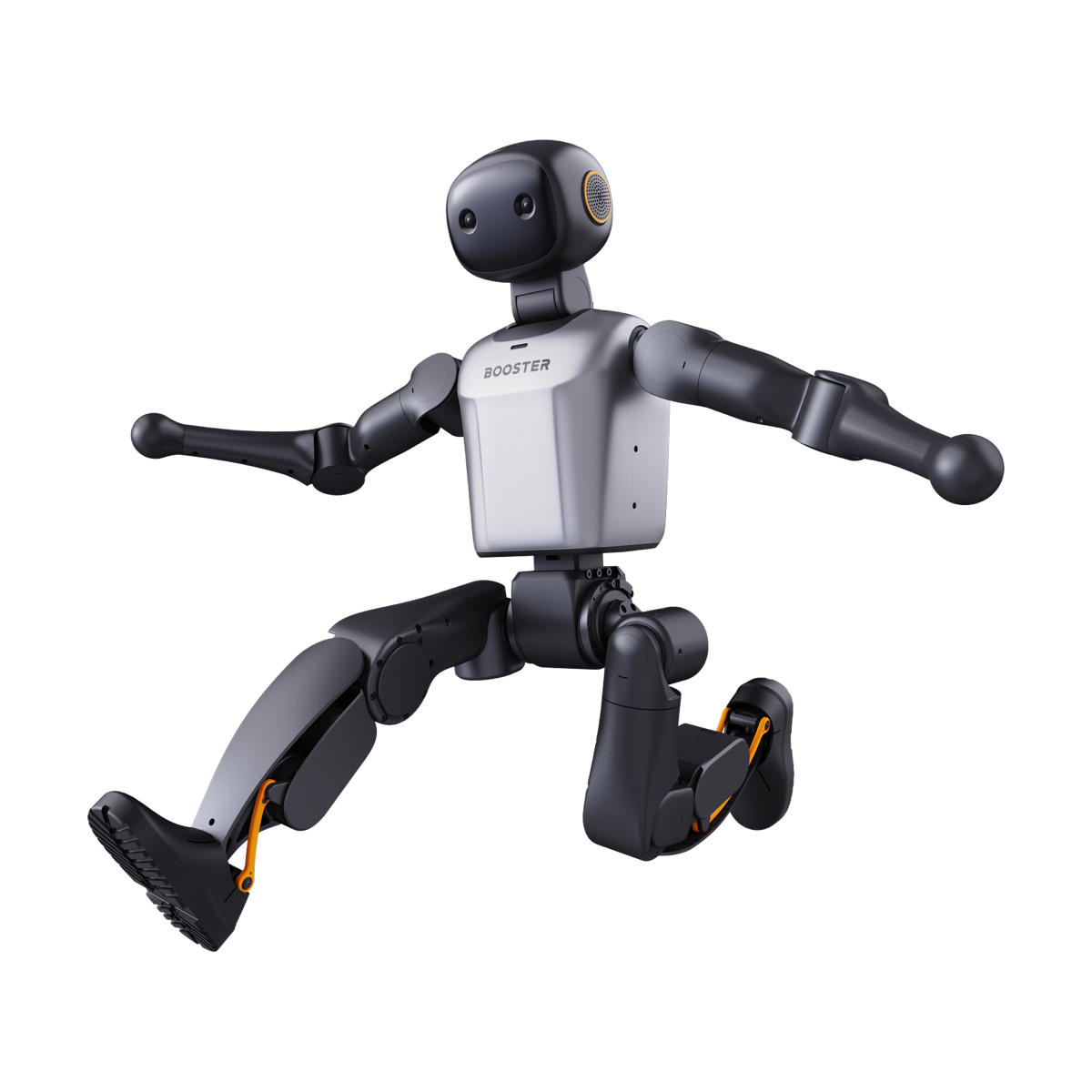
Booster K1 humanoid robot in a running pose

What your robot starts doing

Three capabilities I deliver ready, already running on a humanoid — and the number each one reached.

Real conversation, no waiting your turn

The robot listens while speaking and stops mid-sentence when interrupted — like a person. The conversation flows instead of turning into walkie-talkie turns, and every intent becomes a command on the robot's ROS2 bus.

Barge-in in production, sub-second response, audio and motion 100% local — it keeps working when the link drops.

Safety that doesn't rely on the model being right

Battery, temperature, posture and joint limits become deterministic rules outside the LLM. The model suggests; the rule decides. A machine weighing tens of kilos is not left to a probabilistic system.

A safety SSOT in pure domain code, tested on the physical robot — designed after seeing what happens when that layer isn't there.

Memory that finds the exact term

A part name, an error code, something the operator said once two weeks ago. The robot retrieves it and uses it in the answer, with no cloud round-trip.

The result came from an engineering loop, not luck: measured baseline, one variable per round, metric re-evaluated at every step — 93.5% → 97.3% → 96.8% → 100%. The dip at step three is the proof the measurement was honest: it rejected a change, and the change was rolled back.

100% recall on an 8 GB Jetson Orin, reached through hybrid search and iterative tuning — with an honest denominator at every round.

Results, measured on real hardware

Every number came out of a run on the robot or in simulation — none is an estimate.

100%
event RAG recall, up from 93.5%
8 GB
the Jetson Orin it all runs on, on-device
100%
of motion local — a fall can't wait for the cloud
RL
stable gait from the RL policy, no GPU needed

From simulator to robot, without breaking hardware

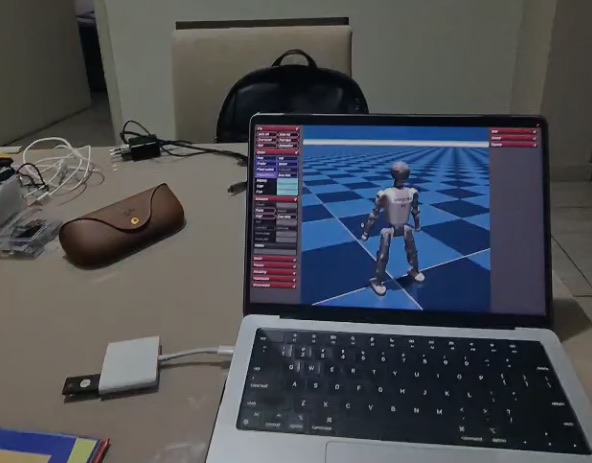
Every motion starts in MuJoCo and only reaches the robot once it holds up in simulation. With the reinforcement learning policy the humanoid walks steadily, keeps its balance and swings its arms naturally.

The whole loop runs without a GPU, on an ARM laptop — which makes testing a gait hypothesis cheap before risking the equipment.

RL-policy gait in MuJoCo — 8 s, only downloads if you press play.
MuJoCo humanoid simulation running on a laptop
The entire simulation loop fits on a laptop.

No GPU, no cluster, no waiting on budget

Physics, RL policy and sim2sim run locally on Apple Silicon. That changes the cost of trying things: you can test a gait hypothesis on Thursday and put it on the robot on Friday.

When the project grows, the same pipeline scales to GPU and cluster — that's the platform side, which is also mine.

The actual robot, not just the render

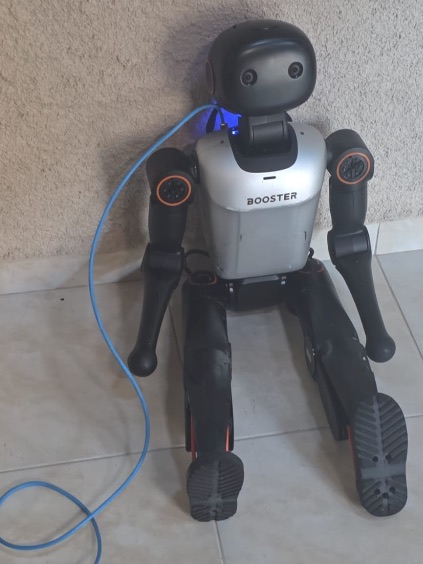
Everything described above was built and measured on this machine — a Booster K1, ethernet cable attached, on a floor at home. Workbench, not press kit.

That is the difference between integrating an SDK and knowing what happens when the hardware behaves differently from what the docs promise.

Booster K1 tethered by an ethernet cable on a workbench
Booster K1 — the robot this work was built and measured on.

What I deliver

From the layer that talks to the motor to the one that talks to the cloud. The overlap is the rare part: people who do LLMs rarely do robots, and people who do robots rarely do platform.

Voice brain

Real-time speech in and out, barge-in, intent orchestration and LLM tool-calls with latency under control.

Deterministic safety

Physical-integrity rules outside the model: battery, temperature, posture and limits the LLM cannot bypass.

On-device memory

RAG that runs on the robot and finds the exact term, not just the similar one. No link required to answer.

Motion and ROS2

ROS2 nodes, topics and services designed for real time; MuJoCo simulation, RL policy and sim2sim through to the physical robot, without breaking hardware on the way.

Platform and edge

Jetson Orin, ROS2, Rust on the critical path, telemetry and remote fleet updates — so the prototype becomes operations.

Diagnosis

When a robot already "almost works": I measure it, tell you where it breaks and what the fix costs.
Physical AI is one part of the work

Robotics is where AI touches the world — but the same engineering carries platform, data and cloud. The whole of it lives on the main site.

bassi.engineer — technical deep-dives, interactive labs, open source projects and 27 years of infrastructure, from sysadmin in 1999 to AI Platform today.

See the full site

Got a robot that needs to understand the world?

Tell me in two lines what it already does and where it stalls. I'll reply saying whether it's my kind of problem — and if it isn't, who to ask.